
Window Restoration
Wood windows are designed to operate smoothly, stay open when needed, seal properly, and lock securely. Over time, excessive paint, building movement, neglect, and poor retrofits cause them to stick, leak air, and stop functioning the way they were built to.
Heritage Restoration surveys, repairs, restores, reproduces, and tunes up old and historic windows so they work the way they were intended to.
Survey
Every project starts here. We document the quantity and condition of each window unit so the owner can decide on the best treatment for each one based on need, performance goals, or budget. No two windows in an old house are identical. A proper survey reflects that.
Tune-Ups
Sometimes a window just needs to be freed up. Paint buildup, misaligned stops, worn parts. Tune-ups remove the obstacles and return a unit to proper operation without altering original materials. It is the lightest intervention we offer and often the most satisfying for the owner.
Restoration
Restoration is the deeper work. Components are stripped, repaired, and refinished. New glazing is installed. Weatherstripping can be added where appropriate. The entire unit is rebuilt to be fully operable and structurally sound. This is once-in-a-century work that returns a window to its original appearance, performance, and longevity.
Onsite Painting
We prep and refinish surfaces that may pose lead hazards. Window troughs, jambs, stops, sills, both interior and exterior. Proper preparation and the right coatings protect the building and keep painted surfaces safe and cleanable.
Onsite Repairs
Common issues come up in nearly every old house. Damaged or missing weight pocket covers. Loose or deteriorated casings. Rot. Broken glass. We address these onsite to stabilize the unit and protect the materials around it.
Certified Lead Safe
A window is considered lead safe when all painted surfaces are sound, and the unit operates without friction or impact that could generate dust. A fully restored window is as clean, functional, and safe as it was the day it was built.
Common Questions About Window Restoration
Can old wood windows be saved, or do I need to replace them?
In almost every case, they can be saved, and usually they should be. Windows made before about 1940 were built from individual parts, and each of those parts can be repaired or replaced without throwing out the whole window. They were also made from old-growth wood, which is far denser and more rot-resistant than anything milled today. A board from a century ago might have twenty or more growth rings per inch, where modern lumber has seven or eight, and that tightness is exactly why these windows have already lasted as long as they have. A window that looks like a lost cause is usually just badly neglected, not beyond help. The honest exception is a sash with widespread deep rot or one that has been altered past recognition, and in those cases, we reproduce it to match, but that is the conclusion of a real evaluation rather than the assumption we start with.
What does restoring an old window actually involve?
It is a methodical process, and the National Park Service lays out the framework for it in Preservation Brief 9, which sorts the work into routine maintenance, stabilization, and parts replacement depending on what the window needs. In practice, it usually goes like this. We survey and document the condition of each window, then remove and label the sashes so they go back exactly where they came from. The old paint comes off using lead-safe methods, the sash is stripped to bare wood, and any rot or damage is repaired. Then the glass is re-glazed with fresh putty, the wood is primed and painted, weatherstripping is added, and the window is rehung and made to operate smoothly again. Most of the sash work happens in our shop, where we can control it, while the frame, channels, and weight pockets are handled on site. The goal is to bring the window back to the way it looked and worked the day it was first installed, which is genuinely a once-in-a-century undertaking when it is done right.
Why won't my old window stay up?
This is one of the most common problems we see, and it is almost always an easy fix. A double-hung window is held open by hidden weights inside the frame, hung on cords that run over pulleys in the jamb. When a cord breaks, the weight drops and the sash loses its counterbalance, so the window slams shut, sits crooked, or will not stay open on its own. The important thing to understand is that a broken cord does not mean the window is bad. The wood, the glass, and the iron weights are virtually always still fine. Only the cord needs to be replaced, which we do through an access cover in the jamb, using cotton sash cord rather than synthetic rope, since synthetic stretches and sags over time. Once it is re-corded, the window opens with one hand and stays exactly where you put it.
What is glazing putty, and when does a window need to be re-glazed?
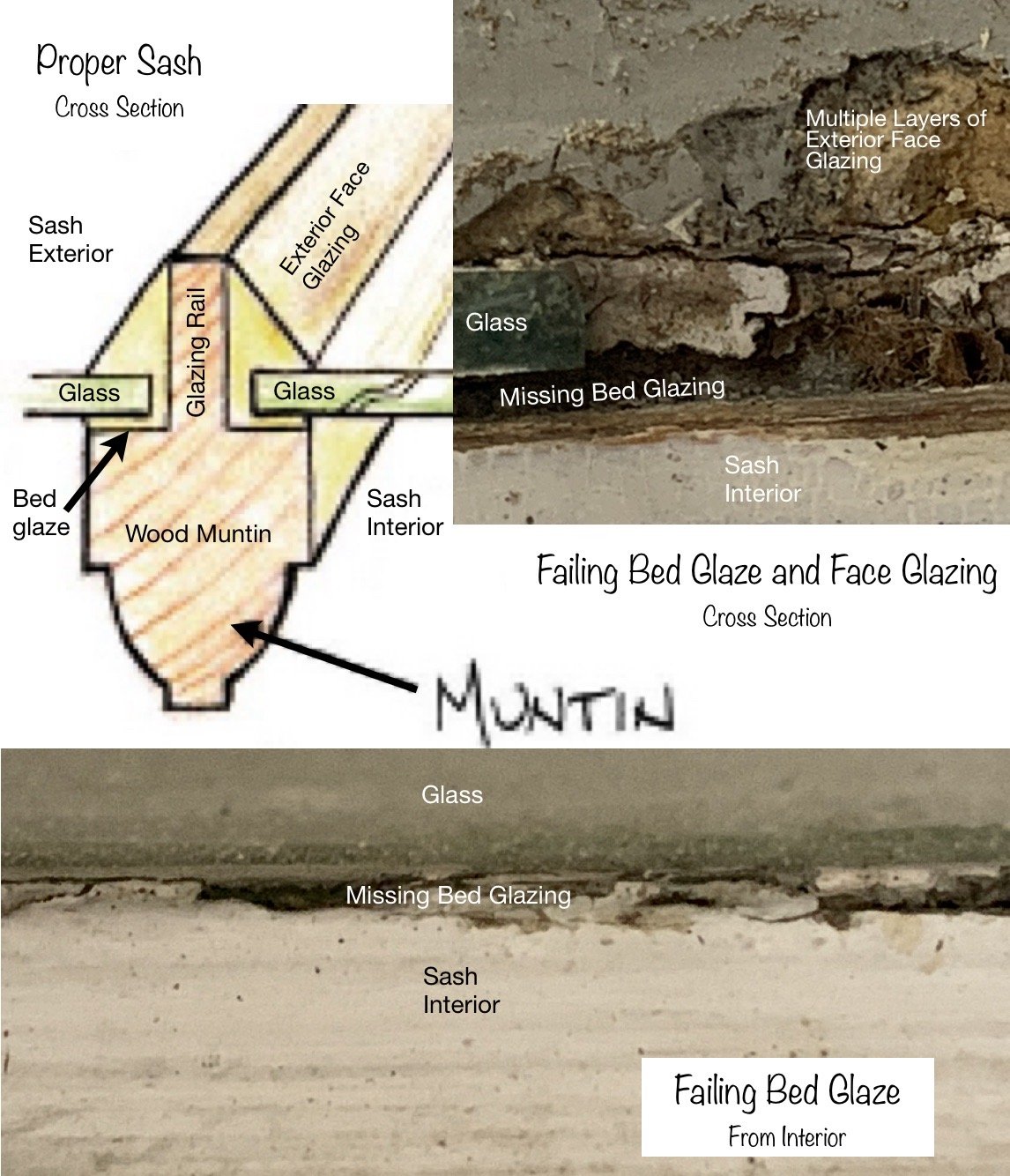
Glazing putty is the material, usually linseed-oil-based, that holds the glass in the sash and seals out water and air. It sits in a thin bed behind the glass and in the angled bead you see on the outside, tooled to a clean line that sheds water. Over time, putty does wear out. It cracks, dries, and pulls away from the glass, and a pane that rattles when you tap it is a sign the seal has failed. Well-maintained and kept painted, putty often lasts around thirty years before it needs renewing, less in harsh sun and more on a sheltered side of the house. Re-glazing is routine maintenance, not a sign of a failing window, and it can usually be done without replacing anything but the putty itself. One detail that matters is that the paint has to lap slightly onto the glass, because that is what actually seals the edge.
Is the wavy glass in my old windows worth keeping?
Yes, and it is worth more than most people realize. That ripple and the occasional bubble come from the way glass was made before modern float glass, which did not arrive until 1959. So, wavy glass is a reliable sign that you are looking at genuinely old material, and it catches and scatters light in a way that flat modern glass simply cannot reproduce. It is also irreplaceable. Once it is gone, a pane of new float glass dropped into an old sash stands out immediately. When we restore a window, we catalog the original glass, clean it, and carefully reinstall it. If a pane is broken beyond saving, we match it with salvaged antique glass or mouth-blown restoration glass rather than ordinary modern glass, so the window keeps its character.
Is lead paint on old windows dangerous, and how do you handle it?
It deserves real care, and windows are the most important place to take it seriously, because they are friction surfaces. Every time a sash slides, paint rubs against paint, and that creates fine lead dust at the meeting rails, jambs, and sills, even when the paint looks intact. That is exactly why we treat windows as the priority in any home built before 1978. We are an EPA Lead-Safe Certified firm, which means we use proper containment, HEPA cleanup, and stripping methods that do not use open flame or high heat over lead paint. The reassuring part is that lead paint is not a reason to tear a window out. A fully restored window, with smooth operation, fresh paint, and the hazards corrected, can be made certified lead safe. We actually helped write the guide on this for the Newport Historic District, where the policy is clear that the presence of lead paint alone is not grounds to replace a historic window, and replacement is treated as a last resort.